
I Spent $1,150 on Four Pairs of APLs After My Foot Gave Out. Here’s What Each One Is Actually For.
The first thing my physical therapist did last March was pick up my shoe and bend it in half.
It folded like a paperback. She held it there, said nothing for a second, then handed it back and asked how long I’d been running in them. Fourteen months. Maybe 700 miles. She told me the plantar fascia doesn’t care how the shoe looked in the box, and that I was going to be off my feet for a while.
Twelve weeks, as it turned out. When I finally got cleared to run again, I had a bad case of the thing every injured runner gets: the conviction that the right shoe would have prevented all of it. That’s not really true. But it did send me back to a brand I’d been curious about and slightly embarrassed to buy, and over the following four months I ended up with four pairs of Athletic Propulsion Labs on my rack and about 380 miles logged across them.
Here’s what I learned, including the parts that annoyed me.
Why APL, and why I felt weird about it
APL has a reputation problem among runners, and it isn’t unearned. The brand came up through Los Angeles, it sells a $350 sneaker, and for years the most visible people wearing them were not running. If you spend time in running forums you’ve seen the shorthand: influencer shoes. Nice-looking foam for people who go to brunch.
I bought my first pair anyway, for a stupid reason. My old rotation had gotten heavy and I wanted something I could pack. Then I ran in them, and the reason stopped being stupid.
What I’ve come around to is this. APL is not trying to build a marathon racer, and if you evaluate their shoes as marathon racers you’ll be disappointed and you’ll be right. What they’ve built instead is a category that barely existed ten years ago: a shoe with real running geometry that you can wear into a restaurant. Every pair here has an 8mm drop, which is a genuinely conventional, uncontroversial running spec. Every pair is vegan and machine washable. And every pair looks like it belongs on a foot that isn’t currently running.
Whether that’s worth the money depends entirely on how many pairs of shoes you want to own. I’ll come back to that.
One housekeeping note before I go further. The links in this piece are affiliate links to Athletic Propulsion Labs. If you buy through one, I get a small commission. Your price is identical either way, and none of it changed what I wrote below, including the paragraph where I tell you not to buy one of these.
APL Veil, Black / Ivory — $350
Let’s start with the newest one, because it’s the one I have the most complicated feelings about.
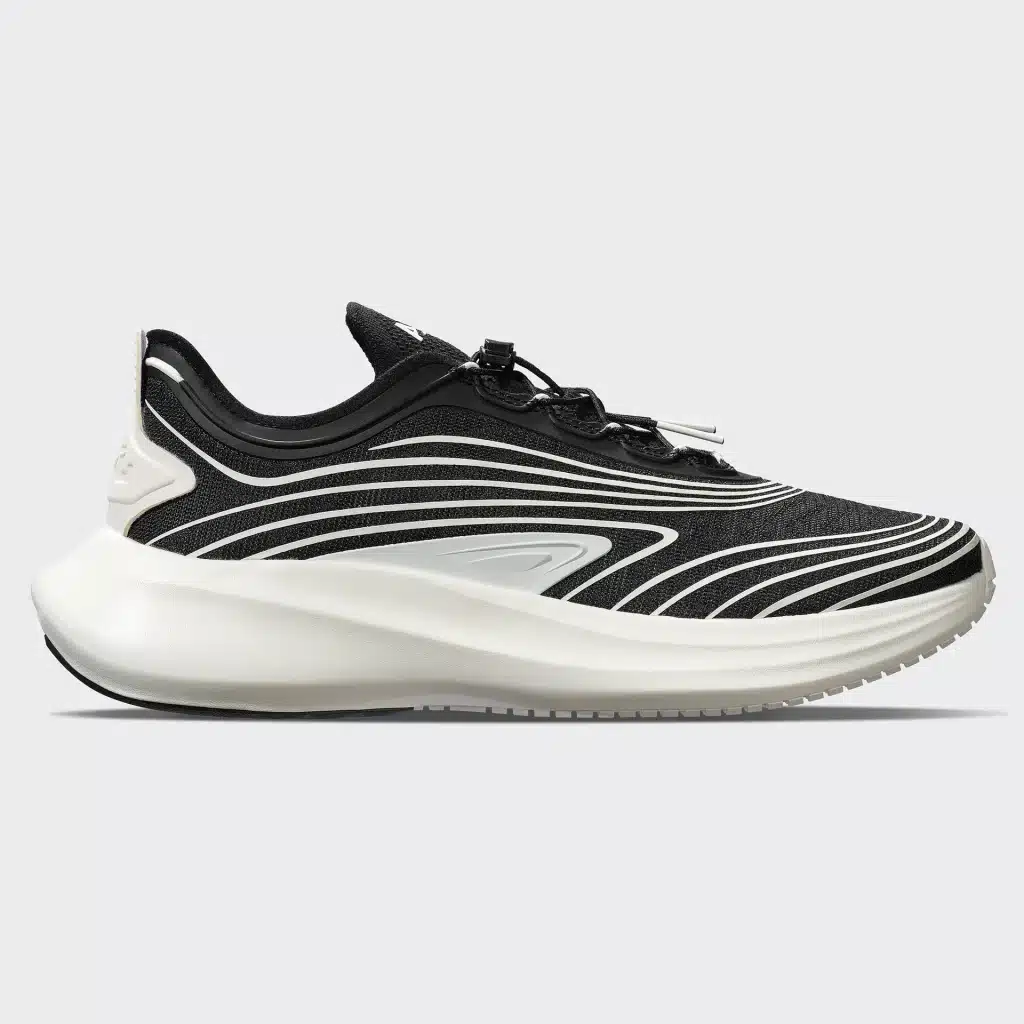
The Men’s APL Veil Black / Ivory is built around one idea, and it’s a good one. Instead of standard flat laces, it runs a thin cord through Zipline eyelets to a quick-pull lock at the top. You pull once and the whole upper closes around your foot. You press the lock and it releases. There is no tying, no double-knotting, no stopping at mile two because the left one worked loose.
I did not expect to care about this. I care about it a lot.
The context where it clicked was a stupid one. I do a lot of runs that start and end at a gym, and the thirty seconds of sitting on a bench dealing with laces at both ends of a session had become a small tax I’d stopped noticing until it disappeared. APL also puts a second, conventional set of laces in the box if you want to swap, which I read as the company hedging. I’ve never swapped them.
The upper is what they call AeroLux+, a segmented mesh with visible flow lines running across it, and the tongue is a stretch TechLoom panel with gussets so it can’t slide sideways. The heel has an external cup with a pull tab built in. Underneath is Heavenly Ride foam over a three-piece rubber outsole, on a 5mm Soufflé sockliner and that same 8mm drop.
Now the part APL doesn’t put on the page.
At 10.5 oz in a men’s 9, the Veil is the heaviest shoe here by almost three ounces. On a five-mile easy run I never noticed. On a nine-miler in July I noticed for the last two miles, and the heat is the second issue: this upper does not breathe as well as the knit models, and other buyers have said the same thing about summer. I have a pair of white socks that came out of an August run looking like I’d worn them in a sauna.
It also fits tighter than the other three. If you have a wide forefoot, this is the one to be careful with.
And there’s a genuinely odd complaint in the reviews that I want to flag because I can’t reproduce it and I don’t think the person is lying. Multiple people describe a suction effect near the heel on hard flat surfaces, where a small section of the shoe grips and then releases with an audible pop on every step. It doesn’t happen to me on asphalt or on the treadmill. One reviewer says it happens across three separate pairs.
The Veil has 24 reviews sitting at 4.83 out of 5, which is a strong average on a small sample. It’s a new shoe. I’d want another six months of data before I called that number stable.
My verdict is the most reserved of the four. The lacing system is legitimately excellent and I’d like to see it on everything APL makes. But you’re paying top of the range for the heaviest, warmest, narrowest shoe in the lineup, and I don’t think the closure alone justifies choosing it over the next one on this list. Buy it if the tighten-and-go thing solves a real problem in your day. Otherwise keep reading.
TechLoom Zipline, Triple Black — $350
This is the one I’d take if someone made me give the other three away.
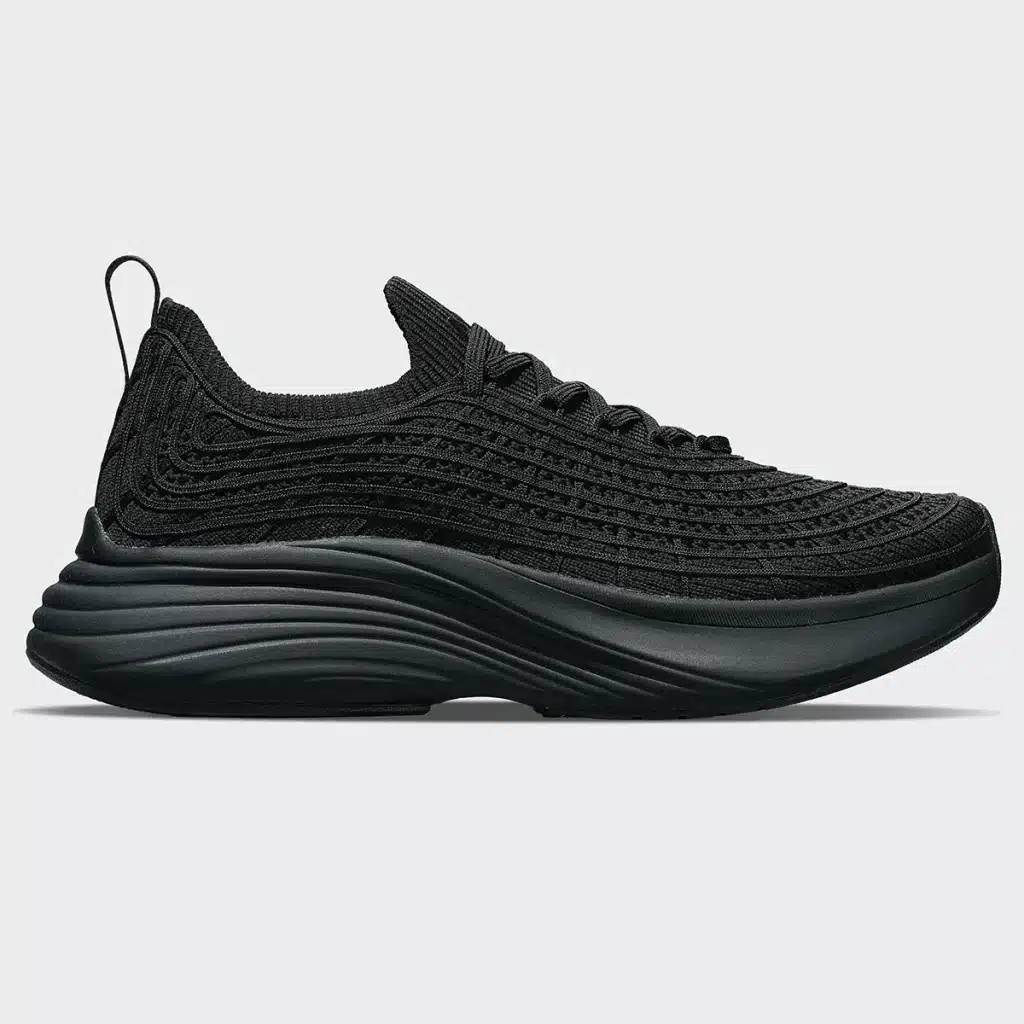
The Men’s TechLoom Zipline Black / Black / Black is APL’s bestseller and their most technically ambitious runner, and unlike the Veil, everything in it is aimed at the same target.
The upper is a single layer of seamless TechLoom with ribbing engineered into the tongue and collar so it stretches exactly where your ankle needs it to. Wrapped around all of that are the Ziplines themselves: hollow cords that band the entire upper, front to back and side to side. They’re hollow so they add support without adding weight, and the effect when you tighten the laces is that the whole shoe contracts around your midfoot as one piece instead of just pulling the two lace panels together.
Underneath is where the actual engineering lives. The FutureFoam midsole comes in two pieces with a forward-slanted shank plate sandwiched between them, positioned to tip you onto your forefoot as you land. There are horizontal channels cut across the midsole surface. Then a 5mm Soufflé sockliner, then a two-piece rubber outsole.
You can feel the shank plate. That’s not a marketing sentence, it’s the single most distinctive thing about running in this shoe. There’s a point in the middle of each footstrike where the shoe stops absorbing and starts pushing, and it arrives slightly earlier than you expect. My first run in these was a 10K on a river path and I finished about forty seconds faster than my usual pace for that loop without trying. Whether that’s the plate or the placebo of new shoes, I can’t separate. But four months later I still turn over faster in these than in anything else I own.
Two things to know before you buy.
First, sizing. This shoe runs small, and it isn’t a minority opinion. Across 831 reviews averaging 4.80, the “go up half a size” advice comes up repeatedly, and one reviewer notes that his wife bought three pairs before he tried them and he sized up on the strength of the reviews and got it right. I’m a 10.5 in most things. I’m an 11 in these and it’s correct.
Second, there’s a real durability complaint on the lighter colorways: paint flaking off the inner forefoot, in the area where your shoes brush against each other as you run. On a $350 shoe that’s not a small thing. It’s also part of why I’d point you at the triple black. There’s no contrast paint to lose, it hides the road grime that white uppers announce to everyone, and it’s the one colorway you can wear with anything without thinking about it.
There is one 1-star review calling the shoe unstable and wobbly. I want to be fair to it: this is a tall, soft midsole with a plate in it, and if you’re a heavy heel-striker or you need medial support, that description is plausible even though it doesn’t match my experience at all.
Also, a small thing that tells you something about how these pages get written. The description text on APL’s own product page says the Zipline weighs 10 oz. The spec block on the same page says 7.7 oz. The 7.7 figure matches what my kitchen scale says, so use that one, but it’s a reminder to weigh things yourself when a number matters to you.
TechLoom Wave, White / White — $270
The Men’s TechLoom Wave White / White has a party trick, and the trick is the reason to own it.
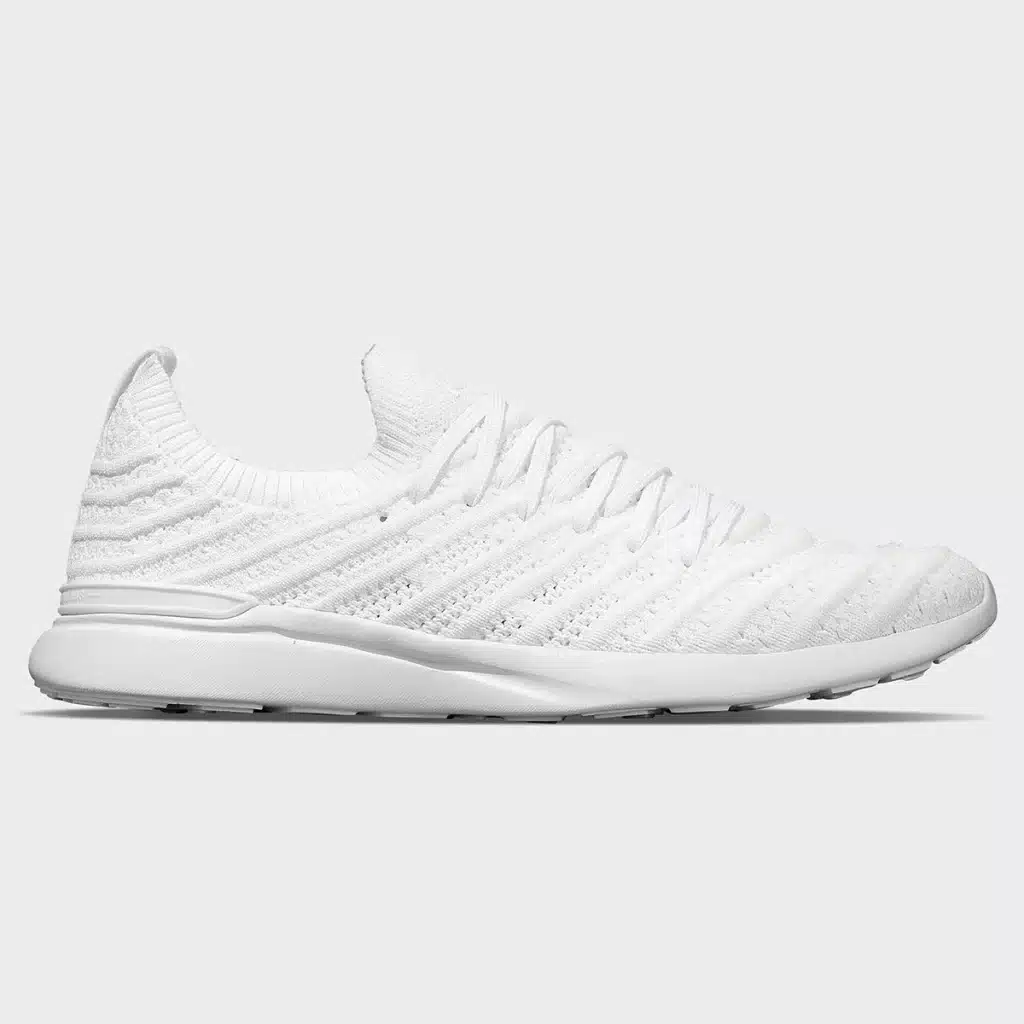
Pull the laces out completely and it becomes a slip-on. Not a slip-on in the sense of a shoe you can jam your foot into and hope. The upper is a high-elastic 3D stretch rebound TechLoom built to stretch front-to-back where your foot articulates while holding you laterally, and there’s an internal cage inside the shoe doing the structural work the laces would normally do. Take the laces out and the cage keeps the fit. If you don’t want to commit, there’s a Phantom lace loop that lets you tuck the laces away instead of removing them.
At 7.1 oz this is the lightest shoe of the four, and lightest by enough that you can feel it in your hand before you feel it on your foot. The midsole is Propelium, APL’s proprietary compound, which they say holds its structure longer than standard EVA. There’s a rubber outsole with a crash pad at the forefoot and ventilation zones placed through the upper.
Here’s the actual use case. I took these to Lisbon in June with one carry-on. They ran with me four mornings, and then they walked me up and down a city built entirely on hills for the rest of each day, laces tucked, looking like a normal white sneaker. The reason I’m confident this isn’t just my experience is that the review section is full of the same story. One woman describes walking seven hours a day through Rome and packing every size of bandage she owned in anticipation of blisters that never showed up.
They’re white, so you’re going to ask about cleaning. The answer is that you put them in a laundry bag, run a delicate cycle, and let them air dry. Mine have been through it twice and they came out looking close to new both times. Do not put them in a dryer.
The complaint, and it’s the same as the Zipline’s: it runs small, and the elastic upper makes the snugness more noticeable. Across 618 reviews at 4.78, there’s a consistent thread about tight fit, including one 1-star review from someone who found them too tight to walk in comfortably and returned them disappointed. Sizes also sell out constantly, so if you find your size in a colorway you like, the wait for a restock is real.
If you own one pair of shoes for a trip, this is the pair.
TechLoom Pro, White / Heritage Blue / Freeze — $180
And this is the one to buy if you’ve read this far and you’re still not sure about any of it.
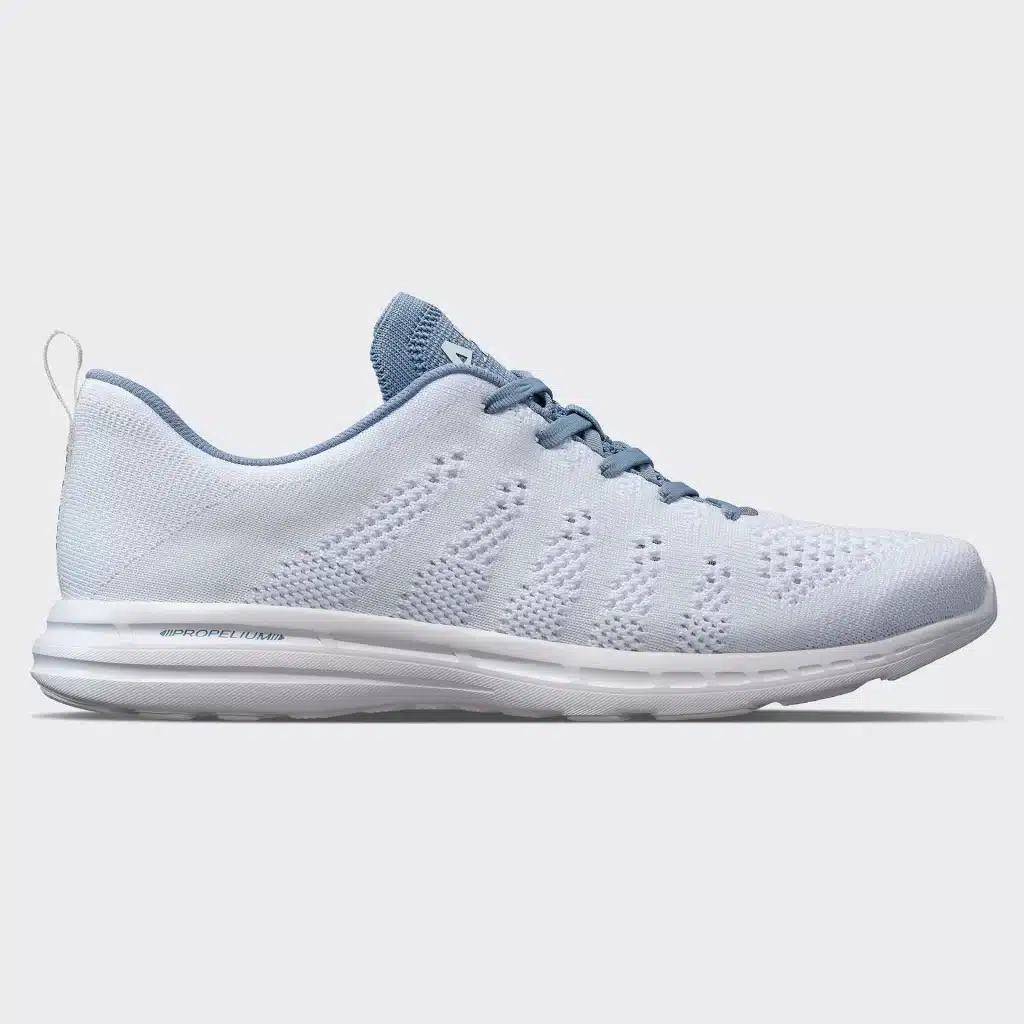
The Men’s TechLoom Pro White / Heritage Blue / Freeze is the original. It’s the shoe APL built the company on, it won an Esquire Editors’ Pick in 2023, and at $180 it’s half the price of the Zipline.
The upper is a patented one-piece woven TechLoom, which means there’s no assembly: support, breathability, flex, and strength are engineered into different zones of a single knitted layer. Underneath, the Propelium midsole is also the outsole. It contacts the ground directly, which lets APL skip most of the rubber and take weight out, and the flex grooves in the bottom are shaped after a feather.
The result is 7.9 oz and a shoe that feels thinner underfoot than everything else here. Not thin in a punishing way. Thin in the way that lets you feel what you’re standing on, which some runners want and some runners specifically don’t.
It also has the most forgiving fit of the four. Standard width with a slightly wider toe box, which after three paragraphs of me telling you the other models run small should register as meaningful. This is the pair I hand to people who want to try the brand.
The honest limitation: this is a 2015-era midsole, and it does not have the return that FutureFoam does. On anything past six or seven miles I notice the difference and I want the Zipline. The Pro is a shoe for daily wear, walking, gym sessions, and shorter runs. Asking it to be your long-run shoe is asking the wrong thing of it.
But this is the highest-value item on the list by a distance. If the question in your head is “is a $350 sneaker insane,” spend $180 first and find out whether the fit and the feel work for you before you commit to the expensive end.
The four side by side
The table below is the summary, but the summary is not the decision. The decision is in the sizing column and in which of the four scenarios above sounds like your week.
| Price | Weight | Midsole | Best for | Sizing | |
|---|---|---|---|---|---|
| APL Veil | $350 | 10.5 oz | Heavenly Ride | Short runs, fast transitions | Runs narrow, tightest of the four |
| TechLoom Zipline | $350 | 7.7 oz | FutureFoam + shank plate | Daily running, longest distances | Runs small, size up a half |
| TechLoom Wave | $270 | 7.1 oz | Propelium | Travel, all-day walking, runs | Runs small and snug, size up a half |
| TechLoom Pro | $180 | 7.9 oz | Propelium (midsole/outsole) | Everyday wear, gym, short runs | Truest fit, slightly wider toe box |
Sizing and care, practically
Three of these four run small. That’s the single most useful thing in this article, so here it is plainly: if you’re between sizes, or if you have any width to your foot at all, order a half size up on the Zipline, the Wave, and the Veil. The Pro is the one where I’d order my normal size.
APL ships free within the US and covers exchanges, which makes the safe play obvious. Order two sizes, walk around indoors on a clean floor, send one back. You have 10 days from receipt to start a return or exchange. If you’re ordering from outside the US, read that policy first, because international orders don’t get exchanges at all and a bad fit becomes a much bigger problem.
Every pair here is machine washable, and that’s not a throwaway feature on shoes this expensive in colorways this light. The method that’s worked for me: laces out, shoes in a mesh laundry bag, cold delicate cycle, small amount of regular detergent, then stuffed with paper and left to air dry somewhere out of direct sun. Two days. The dryer will destroy the midsole adhesive, so don’t.
One more thing. The APL sizing chart lists both men’s and women’s numbers because the shoes are unisex, and if your size is sold out in the men’s listing you can order the women’s version of the same colorway 1.5 sizes up. A men’s 9 is a women’s 10.5. Given how often the Wave sells out, that’s a genuinely useful workaround rather than a technicality.
If you only buy one
Buy the TechLoom Zipline, in black, a half size up.
It’s the only one of the four that’s genuinely good at the thing the brand gets accused of not doing. It has the best midsole, the most support, and the fewest compromises, and the triple-black colorway sidesteps the one durability complaint that shows up in its reviews. I’ve put more miles on it than the other three combined.
If $350 is more than you want to risk on a brand you haven’t worn, start with the Pro and spend the difference on socks. My foot is fine now, incidentally. The therapist was right about the shoe folding in half, and right that it wasn’t the whole story.